Using AI to Write Books Is Not Cheating | Why You’re Still the Author
I Use AI to Write My Books and I'm Not Ashamed — Here's Why You Shouldn't Be Either
Your story deserves to be told. The tool you use to tell it doesn't change that.
Someone sent me a message this week asking what those long dashes are called — the

ones that show up in AI-generated writing — so she could go through and remove them before anyone noticed she'd used AI.
And I felt that. I have done that. Most of us have.
But I had to stop and ask myself: why are we hiding? Why are we sneaking around with a tool that is helping us get our stories told, build our businesses, and show up consistently for the people who need us — and then scrubbing the evidence like we've done something wrong?
I'm done with that. And I think you might be too.
LET'S TALK ABOUT WHAT WE'RE ACTUALLY DOING
When I use AI to write, here is what actually happens: I bring my stories. I bring my hard seasons, my lessons, my specific understanding of the women I serve. I bring my ideas, my voice, my vision for what the book or the post needs to do. Then I have a back-and-forth conversation — a real one — where I'm answering deep questions, making decisions, redirecting, shaping.
The AI brings structure. Sentence flow. Formatting. The ability to take what's in my head and shape it into something readable.
"The story is mine. The hard seasons are mine. The women I'm trying to reach are on my heart, not the machine's. AI doesn't have a story. It has never lived a day."
Now let me ask you this: what is that called when a human does it?
It's called ghostwriting.

Ghostwriting is one of the oldest, most respected, most widely used practices in publishing. A huge percentage of the memoirs, business books, and self-help titles on bestseller lists were written by someone other than the person named on the cover. The author had the ideas, the experiences, the vision. The ghostwriter shaped it into a book. Nobody clutches their pearls about that. Nobody sends the author a message asking if they plan to remove the evidence.
What I do with AI is actually more hands-on than traditional ghostwriting, not less. With a human ghostwriter, you do interviews, hand over your notes, and step back. I am in the process every step of the way — pushing, redirecting, adding, approving. The AI doesn't bring a single idea that isn't mine.
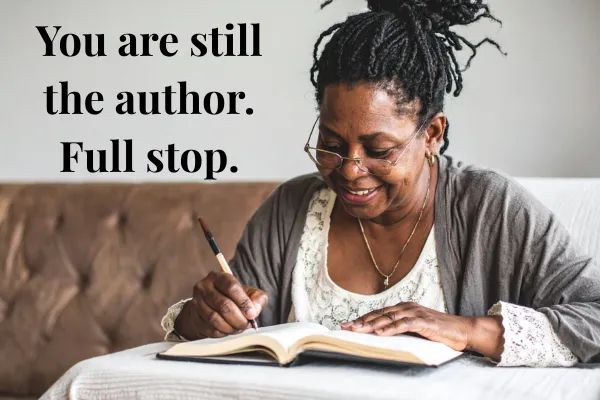
If you have been doing what I do, you are an author. Full stop.
ABOUT THOSE EM DASHES (AND THE OTHER "DEAD GIVEAWAYS")

Let's address this directly because it has gotten out of hand.
People are now claiming they can spot AI writing by looking for em dashes — those long dashes — and for a certain kind of writing pattern where short, punchy phrases stack on top of each other. You've probably seen it. Maybe you've written it:
You are not too late.
You are not too far gone.
You are not behind.
You are right on time.
You know what that is called? Anaphora. It is one of the oldest rhetorical devices in human history. It is in the Bible. It is in every Martin Luther King Jr. speech you have ever loved. It is in Maya Angelou. It is in Churchill. It is in poetry going back thousands of years.
AI learned it from us. From human writers. From the books and essays and speeches humans wrote over centuries. And now humans are being accused of writing like AI when they use a technique humans invented. That is genuinely absurd when you say it out loud.
The em dash? It is on your phone keyboard right now. It has been on keyboards for decades. Authors have always used em dashes — they are a legitimate punctuation mark that creates a specific kind of pause and emphasis. They did not become suspicious because AI started using them. They became suspicious because people decided to make them suspicious.
Here is the truth nobody wants to say: AI was trained by reading human writing. So when AI writes the way humans write, and then humans write that way too, and someone calls it a "dead giveaway" — they are punishing you for writing well. For using rhetorical devices. For knowing how to build emphasis and rhythm.
That is not a fair standard. And you do not have to accept it.
THIS IS BIGGER THAN BOOKS

I work with small business owners and women entrepreneurs who are spending hours — hours they don't have — staring at a blank screen trying to write a social media post. They have a gift, a service, a story that somebody needs. And they are letting days go by without showing up because they can't figure out how to say what they mean.
AI solves that. It does not solve it by thinking for them. It solves it by giving them a starting place, a structure, a first draft they can react to and make their own. And then they show up. And someone they were meant to reach actually finds them.
Is that cheating? Or is that just smart?
We do not shame women for using Canva instead of hiring a graphic designer. We do not shame them for using QuickBooks instead of doing math by hand. We do not tell them their business isn't real because they didn't build their own website from code. Tools exist to help people who have something valuable to offer actually get it out into the world.
AI is a tool. A remarkable, powerful, deeply useful tool — especially for women who have always had something to say but never had the time, the confidence, or the structure to say it.
THE QUESTION THAT KEEPS ME UP AT NIGHT
I work with women who have lived through things. Hard things. Seasons that broke them and rebuilt them. Stories that would reach another woman at 2am who thinks nobody has ever felt what she's feeling.
Those women have been meaning to write their story for years. Life keeps getting in the way. Kids, jobs, caregiving, survival. And quietly, that story — the one that could change someone — keeps getting pushed to someday.
When we shame the tools that make it possible to finally get that story out, we are not protecting the integrity of writing. We are protecting the status quo that says only people with time and traditional training get to tell their stories.
"The women who don't write their stories because they were ashamed of how they'd write them — that is the real loss. Not an em dash."
I refuse to be part of that.
WHAT I ACTUALLY TELL PEOPLE NOW
When someone asks me about my process, I don't hide it. I say: "I write with AI the way some authors write with a ghostwriter. I bring every story, every idea, every woman I'm trying to reach. My AI helps me shape it. The content is mine. The stories are mine. The vision is mine."
Because that is the truth. And the truth is enough.
I also think it is worth saying plainly: you are probably using AI more than you think. Grammar check. Autocomplete. Suggested replies. The line between "assistance" and "AI" has been blurry for a long time. We just didn't have a name for it that scared us.
What has changed is not that technology is helping us write. What has changed is that the technology is powerful enough now that people feel threatened by it. And threatened people look for ways to make others feel small.
Don't let them.
YOU ARE STILL THE AUTHOR

If you have a story that needs to be told — tell it. Use every tool available to you. Use AI. Use voice memos. Use a ghostwriter. Use whatever gets that story from inside you to the people who need it.
Nobody is handing out authenticity awards based on how hard the process was. Your readers don't care whether you agonized for seven years or seven weeks. They care whether your words reach them where they are.
Reach them. Stop hiding. Your story is worth telling — and you are worth being heard.
Until next time. Here I am using Em codes proudly!
Tami
PS After all is said and done, what is really happening online with all the shaming, it usually all comes down to someone is trying to sell you a course! Don't fall for it. You do what is best for you.
About Tami Halliman
Tami Halliman is an author and coach who helps women tell the stories they've always meant to tell — using AI as a powerful, unapologetic tool to finally get them out into the world. She believes every woman has a legacy worth leaving, and that life getting in the way is no longer a good enough reason to stay silent.
Visit her author page at tamihalliman.com
🌸 Mother's Day Special — Words That Matter DIY Course
Ready to stop hiding and start writing? The Words That Matter DIY Course is on sale right now — and it will walk you through exactly how to use AI to write content that sounds like you, reaches the people you're meant to reach, and gets done without the guilt or the overwhelm.
This is for the woman who has been meaning to show up. Your time is now.
👉 Get the course at aiempowersher.com/mothers


