The PROMPT Method: A Simple Way to Get Better Results from AI
If you've ever typed a question into ChatGPT and gotten back something flat, generic, or just plain wrong, the problem usually isn't the AI. It's the prompt.
Most people talk to AI the way they'd type into a search bar: short, vague, and missing context. AI can do far more than that, but only if you give it something to work with. That's why I built the PROMPT Method, a simple six-step framework that helps you write clear, specific prompts every time, even if you've never used AI before.
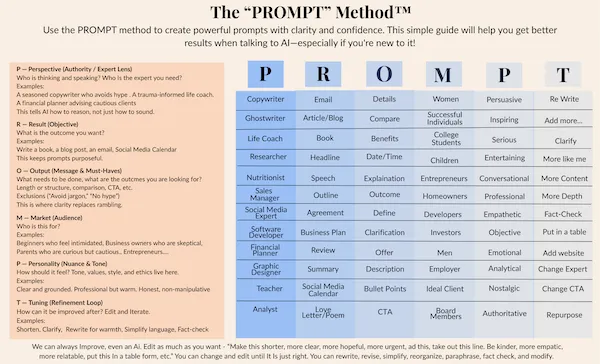
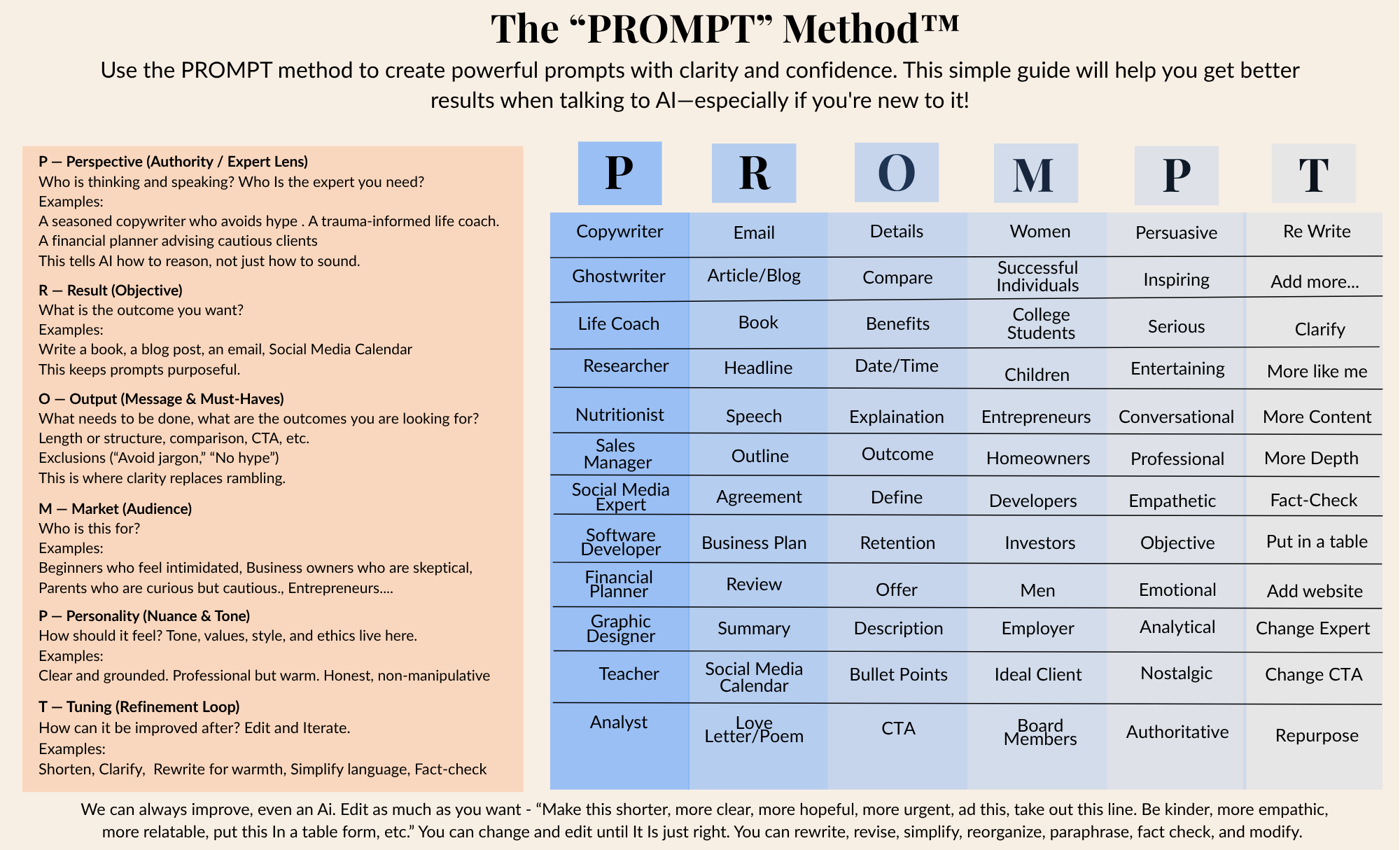
To make this easier to remember and use, I built it this simple visual chart, the one you see below. Each letter breaks down into a quick decision, with examples you can borrow directly if you're not sure where to start. You don't have to memorize anything. Just work through the letters in order, and by the time you reach the end, you'll have a complete, specific prompt instead of a vague one.
Here's how it works.
P: Perspective
Start by deciding who the AI should think and speak as. Not just what topic it should cover, but whose expert lens it should use. Are you looking for the voice of a seasoned copywriter? A trauma-informed life coach? A financial planner speaking to cautious clients?
This step tells AI how to reason, not just how to sound. Skip it, and you'll get a generic, one-size-fits-all answer. Include it, and the response starts to feel like it came from someone who actually knows the subject.
R: Result
What outcome do you actually want? A finished email? A blog post? An outline for a chapter? A social media calendar?
This seems obvious, but it's the step people skip most often. Naming the specific result you want keeps the AI focused and keeps your prompt purposeful instead of open-ended.
O: Output
This is where you get specific about the message itself: the length, the structure, what must be included, and what should be left out. Should it compare two options? List benefits? Include a call to action? Should it avoid jargon or hype?
This is the step that replaces rambling with clarity. The more specific you are here, the less editing you'll have to do later.
M: Market
Who is this actually for? A beginner who feels intimidated? A skeptical business owner? A parent who's curious but cautious?
AI writes very differently depending on who's supposed to be receiving the message. Naming your audience here is what keeps the tone and complexity appropriate for the person who will actually read it.
P: Personality
How should the piece feel? This is where tone, values, and style live. Clear and grounded? Professional but warm? Honest and non-manipulative? Entertaining? Serious?
This step is easy to overlook, but it's often the difference between a response that sounds like a robot and one that sounds like you.
T: Tuning
Your first draft from AI is rarely your last. Tuning is the refinement loop: shorten it, clarify it, rewrite it for warmth, simplify the language, fact-check it. You can keep adjusting until it's right.
This is the step that gives people the most confidence once they understand it. You are allowed to talk back to AI. Ask for it shorter. Ask for it more hopeful. Ask it to take out a line, add urgency, or put the whole thing in a table. You can revise, reorganize, paraphrase, and fact-check as many times as you need. Nothing has to be right on the first try.
Putting It Together
Here's a simple example of the PROMPT Method in action for a social media post:
"Act as a warm, encouraging life coach (Perspective). Write a short Instagram caption (Result) with a clear call to action and no more than four sentences (Output), aimed at women entrepreneurs who feel like they're starting too late (Market), in a tone that's honest and non-manipulative, not salesy (Personality). Then make it more hopeful and shorten it further (Tuning)."
That's it. One sentence per letter, and you've given AI everything it needs to give you something usable on the first or second try.
As a Fun Bonus Prompt, Try This
Take the caption you got from the example above and push it one step further. Instead of stopping at Tuning, add one more round where you swap in a different personality by naming a well-known communicator whose style you want to borrow. A few examples, in case the names are new to you:
Dan Kennedy is a direct-response marketer known for being blunt, decisive, and no-nonsense.
Chonda Pierce is a Christian comedian known for warm, self-deprecating humor and making people feel like an old friend.
Seth Godin is a marketing author known for short, thoughtful, idea-driven writing.
Brené Brown is a researcher and author known for vulnerable, honest, research-backed storytelling.
Once you have your caption from the earlier example, try running it back through with prompts like these:
"Rewrite this in the voice of a blunt, direct-response marketer like Dan Kennedy."
"Rewrite this in the voice of a warm, funny storyteller like Chonda Pierce."
"Rewrite this in the voice of a thoughtful, idea-driven writer like Seth Godin."
Read all three back to back against your original. Notice how differently the exact same message can land depending only on who's "saying" it. Then ask yourself which version your audience would actually respond to right now.
Why This Matters
The women I work with aren't intimidated by AI because it's complicated. They're intimidated because nobody ever showed them how to actually talk to it. The PROMPT Method exists to fix that: a repeatable structure you can use for an email, a book chapter, a business plan, or a social media calendar, without having to reinvent your approach every time.
Once you know the six letters, you'll find yourself using them without even thinking about it. That's when AI stops feeling like a mysterious tool and starts feeling like an assistant you know how to direct.
Tami


