My Full Body Thermography Scan in Gallatin, TN
What I Learned From Having a Full Body Thermography Scan
I went into my thermography appointment hoping to learn whether my body might be showing patterns that could help me ask better questions about my high blood pressure.
I came away with much more education than I expected.
Before the appointment, I knew that thermography produced colorful images showing temperature differences across the body. What I did not fully understand was how the images would be handled afterward, who would review them, or how much information I would receive.
I assumed I would have the scan, receive a collection of thermal images, and be left to figure out what they meant.
That was not what happened.
I received the images, a written report based on physician review, and a consultation that helped me better understand the information. The findings also gave me areas to discuss with my doctor, led me to pursue additional blood work, and encouraged me to pay closer attention to my lymphatic system and inflammation.
I now have a follow-up thermography appointment scheduled so we can compare the new images with my original study and see whether any of the thermal patterns have changed.
Transparency note: I work professionally with Body In Focus Thermography. This article describes my personal experience with the service. It is not medical advice, and thermography should not replace care or testing recommended by your healthcare provider.
Why I Decided to Have a Full Body Thermography Scan
I have been dealing with high blood pressure and wanted to become more informed about what might be happening in my body.
High blood pressure can have many possible causes and contributing factors. I knew that a thermography scan could not diagnose the cause or replace evaluation by my doctor. My hope was that it might document patterns that would help me better understand my body and give me more informed questions to discuss with my physician.
I chose a full body thermography study because I did not want to look at only one area. I wanted a broader picture.
The full body study records thermal patterns from the head and neck through the torso, arms, hands, legs, knees, and feet. It does not look inside the body in the way an MRI, CT scan, ultrasound, or X-ray does. Instead, it records infrared heat emitted from the surface of the skin.
That distinction is important.
Thermography provides information about skin surface temperature patterns. It does not diagnose a disease, identify the cause of high blood pressure, or prove that a particular medical condition is present or absent.
For me, it was another source of information that I could consider alongside my regular medical care.
Why I Chose the Gallatin Location
Body In Focus Thermography offers appointments in several Middle Tennessee communities. I chose the Gallatin location because it was convenient for me.
The Gallatin appointments are held at:
The Movement Shop
210 Baber Park West, Suite 160
Gallatin, TN 37066
Having a local option made the process easier. I did not have to drive into downtown Nashville or travel a long distance for the appointment.
Body In Focus also offers thermography appointments in Hendersonville, Nashville, Clarksville, Murfreesboro, and Cookeville. Clinic dates vary by location, while the Hendersonville home office generally offers more flexible scheduling.
You can view the current Body In Focus thermography locations and choose the one that is most convenient for you.
What the Appointment With April Was Like
My thermography appointment was with April Peters of Body In Focus Thermography.

April is a Clinical Thermographer with approximately 20 years of previous experience as a Licensed Massage Therapist. From the beginning, she explained what would happen and helped me understand the purpose of each part of the appointment.
I felt completely comfortable throughout the experience.
Privacy is understandably an important consideration during full body imaging. April handled the process professionally and respectfully. She explained how I would be positioned, what images she needed to capture, and what she was doing throughout the study.
The infrared camera did not touch me. There was no compression, injection, dye, or ionizing radiation involved in capturing the images.
The process itself felt much more like having a specialized series of photographs taken than undergoing a conventional medical imaging procedure.
Seeing My Thermal Images
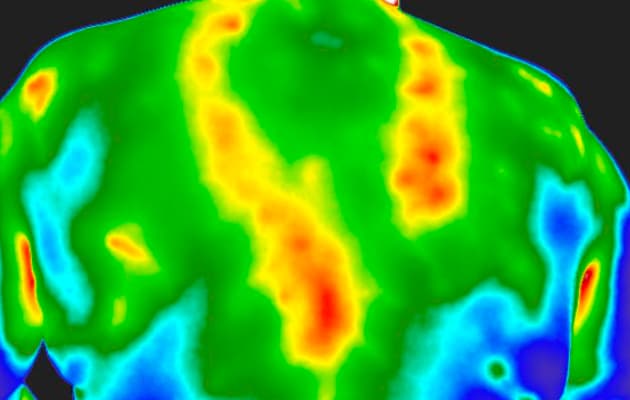
One of the most fascinating parts of the appointment was seeing my thermal images.
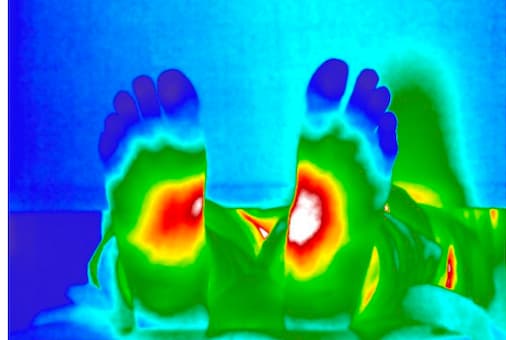
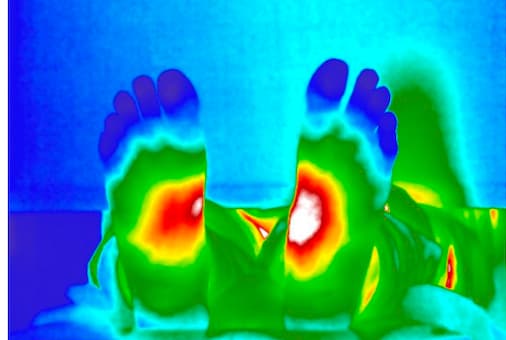
Thermography translates differences in skin surface temperature into colors. Warmer areas may appear in shades of red, orange, yellow, or white. Cooler areas may appear blue, green, or purple.
The colors make it possible to see patterns and temperature differences that would otherwise be invisible.
Seeing your own body displayed this way is fascinating, but it is also easy to look at a bright color and assume it means something alarming. April was careful to explain that the colors themselves are not a diagnosis.
A warmer or cooler area can be influenced by many things, including circulation, recent activity, past injury, physiological activity, environmental conditions, or normal differences in the body. A single thermal image cannot determine the medical cause of a temperature pattern.
That explanation helped me look at the images as information rather than conclusions.
What Surprised Me Most
The biggest surprise came after the images were taken.
I had assumed I would receive the pictures and perhaps a basic explanation from April. I did not realize that my images would be sent for physician review or that I would receive a written report that I could take to my own doctor.
April’s role is to capture the images according to the appropriate thermography protocols. The images are then submitted for professional interpretation.
The report documents observations about the thermal patterns. It may address symmetry, temperature differences, vascular patterns, or areas that may warrant monitoring or discussion with a healthcare provider.
The report does not diagnose a condition. However, it gives the images context and provides information that can be shared with your own physician.
That made the experience much more valuable to me.
Instead of leaving with a group of colorful pictures that I did not understand, I received organized information that could become part of a larger conversation about my health.
The Report and Consultation
When my report was ready, I also received a consultation to help me understand it.
This part of the experience mattered because thermography reports can contain technical terminology. Without explanation, it would be easy to misinterpret a thermal observation or worry unnecessarily about a particular phrase.
The consultation helped me understand what the report was saying, what it was not saying, and which information I might want to discuss with my doctor.
April did not attempt to diagnose me or tell me to disregard conventional medical care. She helped me understand the report so I could become a more informed participant in my own health decisions.
I was able to take the report to my own doctor for him to review within the context of my health history, symptoms, blood pressure, medications, laboratory results, and other medical information.
That is where I believe information like this belongs.
It should support a broader conversation with a qualified healthcare provider, not replace it.
What I Did With the Information
The most valuable part of the experience was that it gave me information I could act on thoughtfully.
Some areas of my thermal images appeared warmer or more active than others. These “hot” areas did not diagnose inflammation or explain what was causing the temperature differences. However, the patterns gave me specific areas and questions to explore further.
I decided to have additional blood work done so I could gather more information related to some of the areas highlighted in the report.
The blood work was not a confirmation of the thermography findings. It was another source of information that could be considered alongside my symptoms, health history, blood pressure, and physician’s evaluation.
I also began paying closer attention to my lymphatic system and to daily choices that may support my body’s natural processes. I started focusing on ways to reduce inflammation and support lymphatic movement as part of my overall wellness routine.
These were personal decisions based on the complete picture of my health, not proof that a particular treatment was required.
For me, the thermography scan served as a starting point for asking more questions and gathering additional information.
Why I Scheduled a Follow-Up Scan
I now have a follow-up appointment scheduled with April.
One potential benefit of thermography is the ability to compare images taken at different points in time. A single scan provides a snapshot of surface temperature patterns on one particular day. A comparison study can show whether those patterns appear stable or have changed.
I want to see whether there are any visible differences after the changes I have implemented.
That does not mean a change in the images will prove that a particular habit, supplement, or wellness practice caused the difference. Many factors can affect skin temperature and thermal patterns.
However, a properly performed comparison study may provide additional information about whether the patterns documented in my first study have remained consistent or changed over time.
This is one reason following the preparation instructions is so important. For a comparison to be useful, both studies need to be completed under similar conditions using consistent imaging protocols.
I am genuinely interested to see what the follow-up images and physician report will show.
Did Thermography Find the Cause of My High Blood Pressure?
No thermography study can diagnose the cause of high blood pressure.
That was not the purpose of the scan, and I would not want anyone to read my experience and assume thermography can replace proper medical evaluation.
What the experience gave me was a different way to observe and think about my body.
It documented surface temperature patterns, provided a report for physician review, and gave me additional information that I could bring into conversations about my health.
It also prompted me to pursue additional blood work and become more intentional about supporting my overall wellness.
Sometimes becoming proactive about your health is not about finding one test that supplies every answer. It is about collecting reliable information, understanding the limitations of each type of testing, and working with qualified professionals to put the pieces together.
What Thermography Can and Cannot Tell You
Thermography records infrared heat emitted from the surface of the skin. It can document temperature distribution, symmetry, vascular patterns, and changes that may be compared over time.
Thermography cannot:
Diagnose the cause of high blood pressure
Diagnose inflammation, cancer, or another disease by itself
Look directly inside internal organs
Replace blood tests or physical examinations
Replace mammograms, ultrasounds, MRI, CT scans, or X-rays
Prove that a medical condition is present
Rule out disease when a thermogram appears normal
Replace care from your doctor
The U.S. Food and Drug Administration specifically warns that breast thermography should not be used as a substitute for mammography. Thermography has not been shown to be effective as a standalone test for breast cancer screening.
Anyone considering thermography should understand those limitations before making an appointment.
What I Would Tell Someone Considering a Scan
Based on my experience, I would offer several suggestions.
Understand why you are having the scan
Be clear about what you hope to learn. Thermography may provide supplementary information, but it is not designed to provide a final diagnosis.
Follow the preparation instructions
Exercise, massage, hot showers, saunas, lotions, sun exposure, and other factors can temporarily affect skin temperature.
Following the preparation instructions helps reduce outside influences on the thermal images.
Body In Focus provides detailed thermography preparation instructions before the appointment.
Ask who interprets the images
Do not assume that the person operating the camera is also medically interpreting the study.
Ask who reviews the images, whether you will receive a written report, and whether you will have an opportunity to ask questions about the results.
Use the report to ask better questions
If the report identifies an unusual thermal pattern, that does not tell you the medical cause.
It may give you a reason to ask your healthcare provider whether additional evaluation or testing would be appropriate. In my case, I chose to gather more information through blood work.
Plan to share the report with your doctor
A thermography report should be considered alongside your medical history, physical examinations, symptoms, laboratory work, and other appropriate testing.
Bring the report to a healthcare provider who understands your overall health.
Do not use a normal thermogram to ignore symptoms
If you have a lump, persistent pain, unexplained symptoms, skin changes, nipple discharge, shortness of breath, severe headaches, chest pain, or another concerning symptom, contact an appropriate healthcare professional.
A normal thermal image cannot rule out disease.
Would I Have Thermography Done Again?
Yes, and I already have my follow-up appointment scheduled.
I appreciated seeing the images, receiving a written report, and having the opportunity to discuss the information afterward.
I also appreciated how comfortable April made the experience. She explained each step clearly, respected my privacy, and helped me understand what thermography could and could not tell me.
Most of all, the experience was educational.
I did not leave believing that thermography had diagnosed the cause of my high blood pressure. I left with more information about my body, a report I could share with my doctor, and a better understanding of which questions I wanted to pursue.
The experience encouraged me to gather additional information through blood work and to become more intentional about supporting my lymphatic system and reducing inflammation in my daily life.
Now I will have the opportunity to compare my original study with a follow-up scan and see whether the documented thermal patterns have changed.
For me, that makes the experience worthwhile.
Where I Had My Thermography Scan
I had my full body thermography study at the Gallatin location with Body In Focus Thermography, owned by April Peters, LMT, CT.
Body In Focus offers breast, half body, and full body thermography appointments at locations across Middle Tennessee, including Nashville, Hendersonville, Gallatin, Clarksville, Murfreesboro, and Cookeville.
You can review the available thermography services and current pricing or view upcoming appointment availability.
If you are considering thermography, ask questions, understand its limitations, and plan to share your report with your healthcare provider.
The greatest value I received was not a diagnosis. It was education, information, and a better opportunity to participate thoughtfully in conversations about my health.
I highly recommend an appointment with April if you have any additional questions or see her website below.
Until next time,
Tami
Sources and Additional Information
Body In Focus Thermography Locations
Body In Focus Thermography Services and Pricing
Body In Focus Thermography Preparation Instructions
U.S. Food and Drug Administration: Breast Cancer Screening, Thermogram No Substitute for Mammogram
This article shares my personal experience and is provided for educational purposes only. It is not medical advice and should not be used to diagnose or treat a health condition.


